Interacting with External Fields
In this tutorial we are going to discuss how to use Arbor and an external simulation of smooth fields to facilitate interaction at the microscopic level, e.g.
stimulation by electric fields as induced by direct currents or magnetic fields [1]
simulations of the extra-cellular medium [2]
As a concrete example, we will model the influence of a time-varying electric field on a single cell.
This is an experimental technique leaning into the implementation details of
Arbor and modcc and as such might be changed sooner or later. For a valuable
outcome, readers should be familiar with modeling cable cells in Arbor, NMODL
and its use in Arbor, the basics of electro-dynamics, and some low-level (C++)
programming.
All source code for all intermediate steps can be in the directory python/example/reading-external-fields of the Arbor source tree.
Single Cell Model
As the first step, we create a single cell model with a sufficiently complex geometry, following the standard method outlined in for example A simple single-cell recipe
import arbor as A
from arbor import units as U

import matplotlib.pyplot as plt
from pathlib import Path

here = Path(__file__).parent

ctr = "(location 0 0.5)"

mrf = A.load_swc_neuron(here / "Acker2008.swc")

dec = (
    A.decor()
    .set_property(Vm=-55 * U.mV)
    .paint('"soma"', A.density("hh"))
    .paint('"dend"', A.density("pas/e=-70"))
    .place(ctr, A.synapse("expsyn"), "syn")
)

cvp = A.cv_policy("(every-segment)")

prp = A.neuron_cable_properties()


class recipe(A.recipe):
    def __init__(self):
        A.recipe.__init__(self)

    def num_cells(self):
        return 1

    def cell_kind(self, _):
        return A.cell_kind.cable

    def global_properties(self, kind):
        return prp

    def cell_description(self, _):
        return A.cable_cell(mrf.morphology, dec, mrf.labels, cvp)

    def event_generators(self, gid):
        return [
            A.event_generator(
                target="syn", weight=50, sched=A.regular_schedule(50 * U.ms)
            )
        ]

    def probes(self, gid):
        return [A.cable_probe_membrane_voltage(ctr, tag="Um")]


if __name__ == "__main__":
    T = 1000
    dt = 0.01
    rec = recipe()
    sim = A.simulation(rec)
    hdl = sim.sample((0, "Um"), A.regular_schedule(10 * dt * U.ms))
    sim.run(T * U.ms, dt * U.ms)
    fg, ax = plt.subplots()
    for data, meta in sim.samples(hdl):
        ax.plot(data[:, 0], data[:, 1], label=meta)
    ax.legend()
    ax.set_xlabel("Time $(ms)$")
    ax.set_ylabel("Membrane potential $(mV)$")
    ax.set_xlim(0, T)
    fg.savefig("single-cell.svg", bbox_inches="tight")
For convenience and the purposes of this tutorial, we store the actual cable cell data as global variables outside the recipe
 9ctr = "(location 0 0.5)"
10
11mrf = A.load_swc_neuron(here / "Acker2008.swc")
12
13dec = (
14    A.decor()
15    .set_property(Vm=-55 * U.mV)
16    .paint('"soma"', A.density("hh"))
17    .paint('"dend"', A.density("pas/e=-70"))
18    .place(ctr, A.synapse("expsyn"), "syn")
19)
20
21cvp = A.cv_policy("(every-segment)")
22
23prp = A.neuron_cable_properties()
We add a spiking input to the soma centre
9ctr = "(location 0 0.5)"
with a regular rate of \(\nu = 1/50ms\)
42    def event_generators(self, gid):
43        return [
44            A.event_generator(
45                target="syn", weight=50, sched=A.regular_schedule(50 * U.ms)
46            )
47        ]
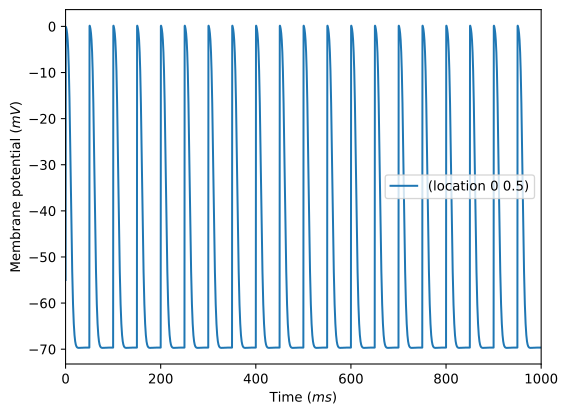
For reference, this is the voltage trace after simulation:
Theory: Injecting Currents by Electric Fields
Now, we want to apply the effects of an electric field \(\vec E(\vec x, t)\) to each segment of the morphology. We follow the quasi-potential approach [3]
and add an extra term to the cable equation
This term can then be absorbed into the cable equation by adding an extra mechanism per segment, feeding it the segment’s endpoints \(\vec x\) and \(\vec x'\) in 3d space and a handle to the vector field \(\vec E(\vec x, t)\). Then, we compute
which converges to the proper result iff the segment lengths are sufficiently small [4], where \(r_\mathrm{L}\) is the familiar axial resistivity.
Let’s step back for a moment and take a look at the morphology
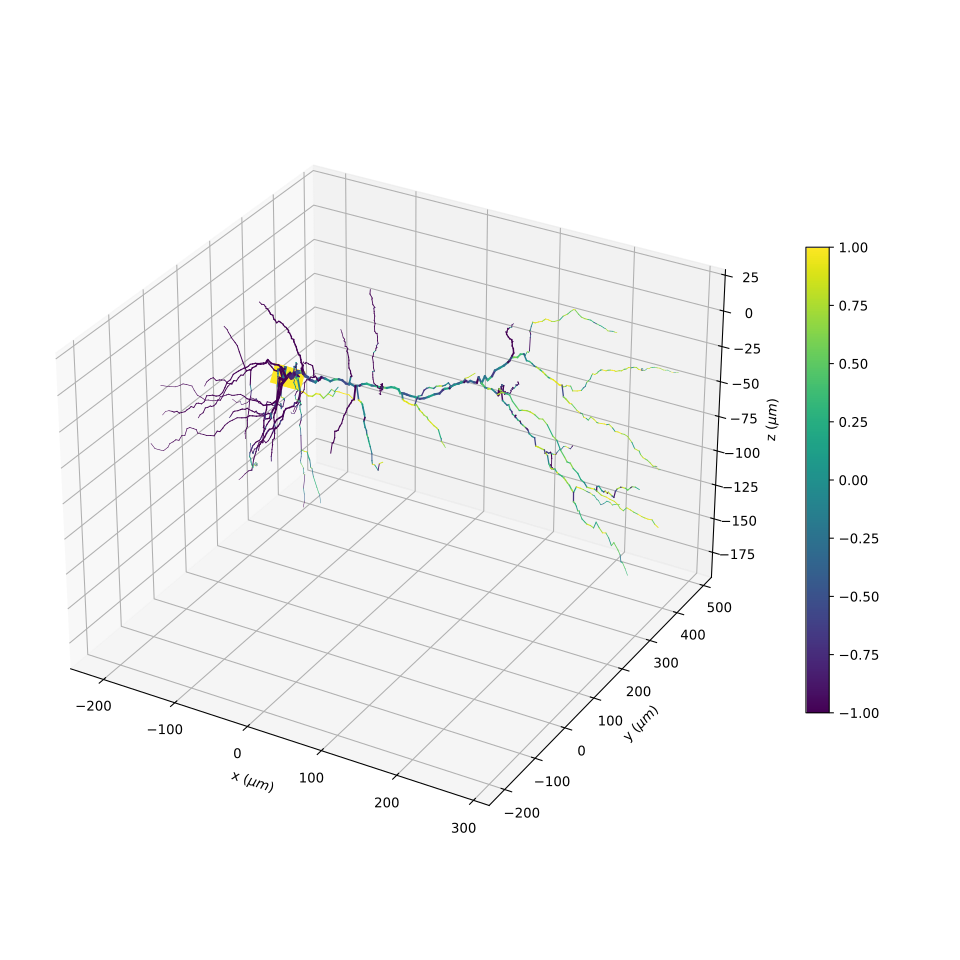
which has been coloured according to the angle to a uniform vector field \(\vec E = (1, 0, 0)\)
Stepping Stone: Implicit Electric Fields
We will now show how to manipulate a standard NMODL mechanism into an injected current for a homogeneous, varying electric field \(\vec E = (E_0 \sin(\omega t), 0, 0)\). This allows us to demonstrate the technique without delving into the implementation details of transferring data from and to C++.
First, we will create a point mechanism in NMODL, then compile it to C++ using
modcc. In the next section, we use the compiled C++ code and change the
implementation to produce the current we want. Without further ado
 1NEURON {
 2    POINT_PROCESS efield
 3    RANGE xp, yp, zp, xd, yd, zd
 4    NONSPECIFIC_CURRENT i
 5}
 6
 7PARAMETER {
 8    xp yp zp : proximal coordinates
 9    xd yd zd : distal coordinates
10    e0       : amplitude
11    omega    : frequency
12    r_axial  : axial resistivity
13}
14
15ASSIGNED { da }
16
17STATE { t }
18
19INITIAL {
20    LOCAL dx, dy, dz
21    : vector spanned by segment endopints
22    dx = xd - xp
23    dy = yd - yp
24    dz = zd - zp
25    : unit length of the segment
26    da = 1.0/(r_axial * sqrt(dx*dx + dy*dy + dz*dz))
27    : time
28    t = 0
29}
30
31BREAKPOINT {
32    SOLVE state METHOD cnexp
33    LOCAL e
34    : electrical field along x
35    e = e0 * sin(omega*t)
36    : induced current
37    i = e*(xd - xp)*da
38}
39
40DERIVATIVE state { t' = 1 }
41
42NET_RECEIVE(weight) {}
This code formalises what we discussed above, if you are unfamiliar with writing mechanisms, please refer to How to use NMODL to extend Arbor’s repertoire of Ion Channels. We pass the desired amplitude and frequency of the E-field, the axial resistivity, the distal and proximal coordinates as parameters
 7PARAMETER {
 8    xp yp zp : proximal coordinates
 9    xd yd zd : distal coordinates
10    e0       : amplitude
11    omega    : frequency
12    r_axial  : axial resistivity
13}
The time is modelled via an ODE
40DERIVATIVE state { t' = 1 }
which is solved to compute the induced current as outlined above
31BREAKPOINT {
32    SOLVE state METHOD cnexp
33    LOCAL e
34    : electrical field along x
35    e = e0 * sin(omega*t)
36    : induced current
37    i = e*(xd - xp)*da
38}
Compile the catalogue
$ arbor-build-catalogue efields mod
Building catalogue 'efields' from mechanisms in [...]/mod
* NMODL
  * efield
Catalogue has been built and copied to [...]/efields-catalogue.so
and it is ready to use. We create a new simulation derived from the one above
 1import arbor as A
 2from arbor import units as U
 3
 4import matplotlib.pyplot as plt
 5from pathlib import Path
 6import numpy as np
 7
 8here = Path(__file__).parent
 9
10ctr = "(location 0 0.5)"
11
12mrf = A.load_swc_neuron(here / "Acker2008.swc")
13
14dec = (
15    A.decor()
16    .set_property(Vm=-55 * U.mV)
17    .paint('"soma"', A.density("hh"))
18    .paint('"dend"', A.density("pas/e=-70"))
19)
20
21cvp = A.cv_policy("(every-segment)")
22
23prp = A.neuron_cable_properties()
24cat = A.load_catalogue(here / "efields-catalogue.so")
25prp.catalogue.extend(cat, "")
26
27e0 = 30.0e-3
28omega = 0.05  # 1/ms
29
30for id, seg in enumerate(mrf.segment_tree.segments):
31    loc = f"(support (on-components 0.5 (segment {id})))"
32    dec.place(
33        loc,
34        A.synapse(
35            f"efield/e0={e0},omega={omega},r_axial={1}",
36            xp=seg.prox.x,
37            xd=seg.dist.x,
38            yp=seg.prox.y,
39            yd=seg.dist.y,
40            zp=seg.prox.z,
41            zd=seg.dist.z,
42        ),
43        label=f"ef{id}",
44    )
45
46
47class recipe(A.recipe):
48    def __init__(self):
49        A.recipe.__init__(self)
50
51    def num_cells(self):
52        return 1
53
54    def cell_kind(self, _):
55        return A.cell_kind.cable
56
57    def global_properties(self, kind):
58        return prp
59
60    def cell_description(self, _):
61        return A.cable_cell(mrf.morphology, dec, mrf.labels, cvp)
62
63    def probes(self, gid):
64        return [A.cable_probe_membrane_voltage(ctr, tag="Um")]
65
66
67if __name__ == "__main__":
68    T = 1000
69    dt = 0.01
70    rec = recipe()
71    sim = A.simulation(rec)
72    hdl = sim.sample((0, "Um"), A.regular_schedule(10 * dt * U.ms))
73    sim.run(T * U.ms, dt * U.ms)
As promised, we add one point process per segment, passing in the endpoints and field parameters, after loading our catalogue into the model
23prp = A.neuron_cable_properties()
24cat = A.load_catalogue(here / "efields-catalogue.so")
25prp.catalogue.extend(cat, "")
26
27e0 = 30.0e-3
28omega = 0.05  # 1/ms
29
30for id, seg in enumerate(mrf.segment_tree.segments):
31    loc = f"(support (on-components 0.5 (segment {id})))"
32    dec.place(
33        loc,
34        A.synapse(
35            f"efield/e0={e0},omega={omega},r_axial={1}",
36            xp=seg.prox.x,
37            xd=seg.dist.x,
38            yp=seg.prox.y,
39            yd=seg.dist.y,
40            zp=seg.prox.z,
41            zd=seg.dist.z,
42        ),
43        label=f"ef{id}",
44    )
Note, that we set the axial resistivity to the unit value here to simplify the parameter setup. In production simulations, this needs to be adjusted to the electrophysiology, possibly varying in space along the dendrite.
We plot the membrane potential and induced current over time
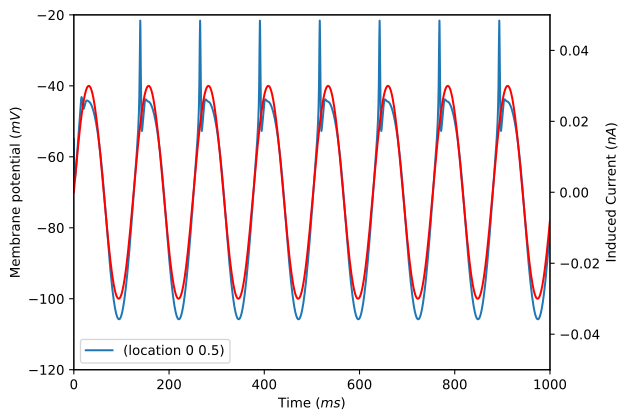
and clearly observe the influence of the driving current and non-linearity of the HH-mechanism.
If you can – analytically or otherwise – determine the value of \(\vec E(\vec r, t)\) at the coordinates of the segment centres without reliance on external tools, this approach is sufficient and there is no need for the techniques demonstrated in the rest of this tutorial. The same holds for other quantities interacting with the simulation.
(Ab)using NMODL to Create Custom Mechanisms
Now, this gives us a current on every segment, but for interfacing with an external simulation, we need to enable the mechanism to read from that source. For this, we create a new point mechanism with a similar layout as above
 1NEURON {
 2    POINT_PROCESS template
 3    RANGE xp, yp, zp, xd, yd, zd
 4    NONSPECIFIC_CURRENT i
 5}
 6
 7PARAMETER {
 8    field
 9    xp yp zp : proximal coordinates
10    xd yd zd : distal coordinates
11    r_axial  : axial resistivity
12}
13
14ASSIGNED { da }
15
16STATE {}
17
18INITIAL {
19    LOCAL dx, dy, dz
20    : vector spanned by segment endopints
21    dx = xd - xp
22    dy = yd - yp
23    dz = zd - zp
24    : unit length of the segment
25    da = 1.0/(r_axial * sqrt(dx*dx + dy*dy + dz*dz))
26}
27
28BREAKPOINT {
29    LOCAL e
30    : electrical field along x
31    e = 42
32    : induced current
33    i = e*(xd - xp)*da
34}
35
36
37NET_RECEIVE(weight) {}
This will not be used in a simulation, but rather we will compile it to C++
$ arbor-build-catalogue --debug tmp efields mod
Building catalogue 'efields' from mechanisms in [...]/mod
* NMODL
  * template
  * efield
Building debug code in '[...]/tmp'.
Catalogue has been built and copied to [...]/efields-catalogue.so
By using the debug mode, the intermediate C++ files will be preserved in the
tmp directory, and we can edit and add them back to the catalogue. Open
tmp/build/generated/efields/template_cpu.cpp and take a look at the
compute_currents function
static void compute_currents(arb_mechanism_ppack* pp) {
    PPACK_IFACE_BLOCK;
    for (arb_size_type i_ = 0; i_ < _pp_var_width; ++i_) {
        auto node_indexi_ = _pp_var_node_index[i_];
        arb_value_type current_ = 0;
        arb_value_type i = 0;
        arb_value_type e;
        e =  42.0;
        i = e*(_pp_var_xd[i_]-_pp_var_xp[i_])*_pp_var_da[i_];
        current_ = i;
        _pp_var_vec_i[node_indexi_] = fma(_pp_var_weight[i_], current_, _pp_var_vec_i[node_indexi_]);
    }
}
Note that if you have SIMD enabled, this might look differently. We recommend disabling SIMD for this tutorial, since the generated C++ is simpler to follow.
We are going to continue, as before, under the assumption that the electric
field is homogeneous, so we need only to concern ourselves with three double
numbers. Generalizing to complete fields is straightforward, if tedious [5].
Copy the two files tmp/build/generated/efields/template_cpu.cpp and
tmp/build/generated/efields/template.hpp into the mod directory and
rename them to mod/reader.hpp and mod/reader_cpu.hpp.
cp tmp/build/generated/efields/template.hpp mod/reader.hpp
cp tmp/build/generated/efields/template_cpu.cpp mod/reader_cpu.cpp
then we adjust the interface names so we can use them in our catalogue:
sed -i '' 's/template/reader/g' mod/reader_cpu.cpp
sed -i '' 's/template/reader/g' mod/reader.hpp
sed -i '' 's/make__reader_/make_arb_efields_catalogue_reader/g' mod/reader_cpu.cpp
sed -i '' 's/make__reader_/make_arb_efields_catalogue_reader/g' mod/reader.hpp
on MacOS while Linux users drop the ''. Now, you should be able to compile
the catalogue again
$ arbor-build-catalogue fields mod --raw reader
Building catalogue 'efields' from mechanisms in [...]/mod
* NMODL
  * template
  * efield
* Raw
  * reader
Building debug code in '[...]/tmp'.
Catalogue has been built and copied to [...]/efields-catalogue.so
This has built an extra point process reader from a raw C++ implementation.
Let’s take it for a test drive using a new simulation
 1import arbor as A
 2from arbor import units as U
 3
 4import matplotlib.pyplot as plt
 5from pathlib import Path
 6import numpy as np
 7
 8here = Path(__file__).parent
 9
10E = np.zeros(shape=(3,), dtype=np.float64)
11
12ctr = "(location 0 0.5)"
13
14mrf = A.load_swc_neuron(here / "Acker2008.swc")
15
16dec = (
17    A.decor()
18    .set_property(Vm=-55 * U.mV)
19    .paint('"soma"', A.density("hh"))
20    .paint('"dend"', A.density("pas/e=-70"))
21)
22
23cvp = A.cv_policy("(every-segment)")
24
25prp = A.neuron_cable_properties()
26cat = A.load_catalogue(here / "efields-catalogue.so")
27prp.catalogue.extend(cat, "")
28
29e0 = 30.0e-3
30omega = 0.05  # 1/ms
31
32for id, seg in enumerate(mrf.segment_tree.segments):
33    loc = f"(support (on-components 0.5 (segment {id})))"
34    dec.place(
35        loc,
36        A.synapse(
37            f"reader/field={0xC0FFEE},r_axial={1}",
38            xp=seg.prox.x,
39            xd=seg.dist.x,
40            yp=seg.prox.y,
41            yd=seg.dist.y,
42            zp=seg.prox.z,
43            zd=seg.dist.z,
44        ),
45        label=f"ef{id}",
46    )
47
48
49class recipe(A.recipe):
50    def __init__(self):
51        A.recipe.__init__(self)
52
53    def num_cells(self):
54        return 1
55
56    def cell_kind(self, _):
57        return A.cell_kind.cable
58
59    def global_properties(self, kind):
60        return prp
61
62    def cell_description(self, _):
63        return A.cable_cell(mrf.morphology, dec, mrf.labels, cvp)
64
65    def probes(self, gid):
66        return [A.cable_probe_membrane_voltage(ctr, tag="Um")]
67
68
69if __name__ == "__main__":
70    T = 1000
71    dt = 0.01
72    rec = recipe()
73    sim = A.simulation(rec)
74    hdl = sim.sample((0, "Um"), A.regular_schedule(10 * dt * U.ms))
75    t = 0
76    while t < T:
77        E[0] = e0 * np.sin(omega * t)
78        sim.run((t + T) * U.ms, dt * U.ms)
79        t += 1
We added the electric field vector
10E = np.zeros(shape=(3,), dtype=np.float64)
and swapped the point process for reader passing nono-sense data to field
32for id, seg in enumerate(mrf.segment_tree.segments):
33    loc = f"(support (on-components 0.5 (segment {id})))"
34    dec.place(
35        loc,
36        A.synapse(
37            f"reader/field={0xC0FFEE},r_axial={1}",
38            xp=seg.prox.x,
39            xd=seg.dist.x,
40            yp=seg.prox.y,
41            yd=seg.dist.y,
42            zp=seg.prox.z,
43            zd=seg.dist.z,
44        ),
45        label=f"ef{id}",
46    )
and our simulation is now stepping in increments of 1ms after which we change the x-component of the electric field
76    while t < T:
77        E[0] = e0 * np.sin(omega * t)
78        sim.run((t + T) * U.ms, dt * U.ms)
79        t += 1
Final Step: Getting Data from NumPy into C++
Now we need to wire our ‘simulation’ of the electric field into the custom mechanism. To that end, we need to acquire the pointer to the backing data of the NumPy array.
 7import ctypes
 8
 9E = np.zeros(shape=(3,), dtype=np.float64)
10buf = ctypes.c_double * 3
11addr = ctypes.addressof(buf.from_buffer(E))
We use ctypes to fetch the pointer from the array. However, this is a
somewhat brittle process and the machinery relies on this pointer never
changing again. This means, you can write to the array like this
E[0] = 31.0
which does not change the backing memory, just the values contained within. This, however, does
x = np.array(...)
y = np.array(...)
E = x + y
and thus breaks the programm, as do all operations that assign a new array to
E.
Next, we pass the pointer to the mechanism
34for id, seg in enumerate(mrf.segment_tree.segments):
35    loc = f"(support (on-components 0.5 (segment {id})))"
36    dec.place(
37        loc,
38        A.synapse(
39            f"reader/field={addr},r_axial={1}",
40            xp=seg.prox.x,
41            xd=seg.dist.x,
42            yp=seg.prox.y,
43            yd=seg.dist.y,
44            zp=seg.prox.z,
45            zd=seg.dist.z,
46        ),
47        label=f"ef{id}",
48    )
Note that we pass an integral value as a floating point number, which is questionable, but a fix requires tweaking the NMODL language and might happen in the future. For demonstration purposes, we shift the sine wave by 50ms versus the implicit field example
77    t = 0
78    while t < T:
79        E[0] = e0 * np.sin(omega * (t + 50))
80        sim.run((t + 1) * U.ms, dt * U.ms)
81        t += 1
All that’s left to do is to read the field value from the reader mechanism
86static void compute_currents(arb_mechanism_ppack* pp) {
87    PPACK_IFACE_BLOCK;
88    auto e_field_ptr = (double*)((uint64_t) _pp_var_field);
89    for (arb_size_type i_ = 0; i_ < _pp_var_width; ++i_) {
90        auto node_indexi_ = _pp_var_node_index[i_];
91        arb_value_type e = e_field_ptr[0];
92        arb_value_type i = e*(_pp_var_xd[i_]-_pp_var_xp[i_])*_pp_var_da[i_];
93        _pp_var_vec_i[node_indexi_] = fma(_pp_var_weight[i_], i, _pp_var_vec_i[node_indexi_]);
94    }
95}
First, we cast the floating point value to a double-valued array
88 auto e_field_ptr = (double*)((uint64_t) _pp_var_field);
then we read the first value \(E_x\), use it to compute the current i as \(I = \frac{E_x a_x}{r_\mathrm{L}|a|}\)
91        arb_value_type e = e_field_ptr[0];
92        arb_value_type i = e*(_pp_var_xd[i_]-_pp_var_xp[i_])*_pp_var_da[i_];
which is written back the data consumed by Arbor’s cable equation solver
93 _pp_var_vec_i[node_indexi_] = fma(_pp_var_weight[i_], i, _pp_var_vec_i[node_indexi_]);
Conclusions
We have seen how custom C++ mechanisms can source data from external data and they can be created, relatively simply, from NMODL templates. There are many ways to use this, examples include driving two simulations exchanging data over a shared memory segment, using a network connection to obtain values from external sources, and many more. The largest hurdle here is the synchronisation between Arbor and the external data source.
It might be prudent to note that this approach will be slow, both in terms of setup and execution. We are explicitly adding one point process to each segment and setting its coordinates. Also, technically, setting both proximal and distal coordinates is redundant as segments (mostly) share their endpoints. The way the simulation is set up, the time is stepped at the granularity of the electric field evolution. We would much rather use asynchronous simulations and a lightweight signalling mechanism.